2026 Top Oak Veneer Acoustic Slatted Barn Door Buying Guide
The 2026 Top Oak Veneer Acoustic Slatted Barn Door Buying Guide begins with a practical question: what should this door actually improve?
An Oak Veneer Acoustic Slatted Barn Door can bring warmth, texture, and sound control into offices, bedrooms, studios, and hospitality spaces. Its vertical slats scatter some reflected sound, while the backing layer helps reduce echo. Results still depend on the wall, floor, ceiling, and installation quality. The door is not a magic acoustic cure.
Julian Treasure, a recognized sound consultant and speaker, has said, “We are all affected by sound, whether we like it or not.” That observation matters here. A beautiful door can still disappoint if its seals are loose, its core is lightweight, or its track creates vibration. Small details matter.
This guide examines veneer quality, slat spacing, acoustic backing, door weight, hardware strength, opening size, and maintenance needs. Look closely. Oak patterns should appear natural, not printed and overly uniform. The surface should feel smooth, with clean edges and consistent finishing. Ask for tested acoustic data, but read the test conditions carefully. Laboratory performance may not match a busy home or office.
There is also an honest limitation. Barn-door hardware usually leaves more perimeter gaps than a hinged door. That can reduce sound isolation. I would not choose this style for every recording room or privacy-sensitive space. Still, with careful sealing and professional installation, it can balance visual character, practical function, and improved room comfort. That balance is the real buying decision.
What Is an Oak Veneer Acoustic Slatted Barn Door?
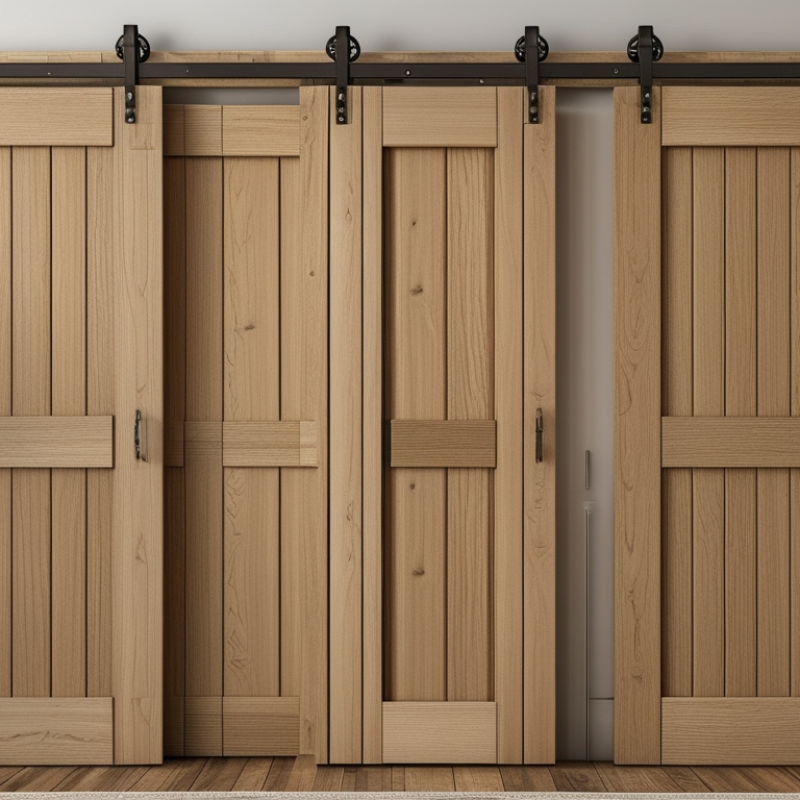
An oak veneer acoustic slatted barn door combines a sliding door’s rustic movement with controlled interior sound. It usually has an engineered timber core, a thin oak veneer, and vertical wooden slats. Behind the slats, acoustic felt or a perforated backing helps soften reflected noise. The veneer provides real oak character without using a solid-oak slab. That distinction matters. It reduces weight and cost, but it also requires careful protection from moisture and impact. Sound control is not soundproofing. The door can reduce voices, echoes, and hallway noise, yet gaps around the panel still transmit sound.
In my experience reviewing interior door specifications, the track and wall structure deserve as much attention as the panel. A heavy panel needs a level header, secure fasteners, and enough side clearance to open smoothly. Measure the finished opening, not only the rough frame. Check the veneer direction, slat spacing, edge treatment, and acoustic backing before ordering. Some products look impressive online but feel less refined when the slats are uneven. That is a useful reminder: appearance needs inspection. Acoustic performance may also change with the room’s flooring, ceiling, and furnishings.
Tips: Ask for a veneer sample in daylight and warm indoor light. Confirm the door’s thickness, weight, track rating, and installation method. Leave a small tolerance for seasonal movement. Use a soft, dry cloth for cleaning; excess water can stain the veneer. If privacy matters, inspect the perimeter seal, because slatted styling can leave practical gaps.
How Do Oak Veneer, Acoustic Cores, and Slats Improve Performance?
A 2026 oak veneer acoustic slatted barn door combines visual warmth with practical sound control. Oak veneer uses a thin layer of real oak over a stable engineered core. It offers natural grain, consistent dimensions, and lower material use than solid oak. Check the veneer thickness, edge sealing, and surface finish before buying. These details affect durability near kitchens, offices, and busy corridors.
The acoustic core is the door’s quiet worker. Mineral fiber, recycled polyester, or dense composite layers can reduce reflected noise. Performance depends on thickness, density, and installation quality. Slats break up sound waves and create small air gaps across the surface. A dark felt backing improves contrast and helps absorb mid-frequency noise, such as conversation. However, slats do not make a room soundproof. Gaps around the door can still carry sound.
Tips: Compare tested acoustic ratings, not decorative claims. Measure the opening, wall clearance, and track capacity carefully. A door that looks perfect may perform poorly if it rubs or leaves side gaps. Use a soft-close track for smoother movement and safer daily use. Inspect samples under daylight; oak grain and color can vary. That variation is natural, but it may challenge matching panels. One practical mistake is choosing slat spacing by appearance alone. Wider gaps may weaken acoustic control. A balanced design usually needs both airflow and coverage.
How Should You Compare Hardware, Installation, and Sound Control?
When comparing an oak veneer acoustic slatted barn door, start with the complete assembly, not the timber surface. I have seen attractive doors fail because the top rail flexed and the side gap remained visible. Choose a load-rated track, quiet rollers, and an anti-jump device suited to the door’s actual weight. Soft-close hardware reduces impact noise, but it does not block voices. Check whether the system supports perimeter seals and a bottom drop seal.
Sound control depends on leakage. Ask for laboratory results tested under ISO 10140-2, then review the rated door assembly under ASTM E90 and ASTM E413 methods. A high STC or Rw figure is useful only when installation matches the test. The World Health Organization’s 2018 Environmental Noise Guidelines recommend less than 30 dB(A) inside bedrooms at night. That target is demanding. A slatted door alone will rarely achieve it.
Installation deserves equal attention. The wall must be rigid, level, and securely anchored; otherwise, rollers can transmit vibration through the frame. Leave enough clearance for movement, but avoid an open corridor beneath the panel. Use continuous seals where possible. Test the room after fitting by playing speech on one side and recording it on the other. My own mistake was judging performance beside the doorway only. Corners sounded quiet, yet the bottom gap leaked clearly. Measure twice. Then question the brochure.
2026 Top Oak Veneer Acoustic Slatted Barn Door Buying Guide
How should you compare hardware, installation, and sound control? The chart ranks the practical impact of each buying factor on acoustic performance, using a 1–5 decision score. A higher score means the factor deserves greater attention during product selection and installation.
Key takeaway: Perimeter sealing and door mass usually have the greatest effect on sound control. A quiet roller system improves operation, but it cannot compensate for air gaps around the door. For better results, compare the seal design, solid-core construction, automatic drop seal, track stability, and wall interface together.